Урок 1 из 4 · 9 мин
The penetration-testing lifecycle: attacking with permission
What separates a penetration test from an attack, the phases every professional test follows, and why the report is the real product.
Пока эта страница на английском.
A penetration test is a simulated attack, carried out with permission, to find weaknesses before real attackers do. NIST defines it as security testing in which evaluators mimic real-world attacks to identify ways to circumvent the security features of an application, system or network. The techniques can look identical to a criminal’s. The difference is everything around them: authorization, scope, rules, and a report written to help the defenders.
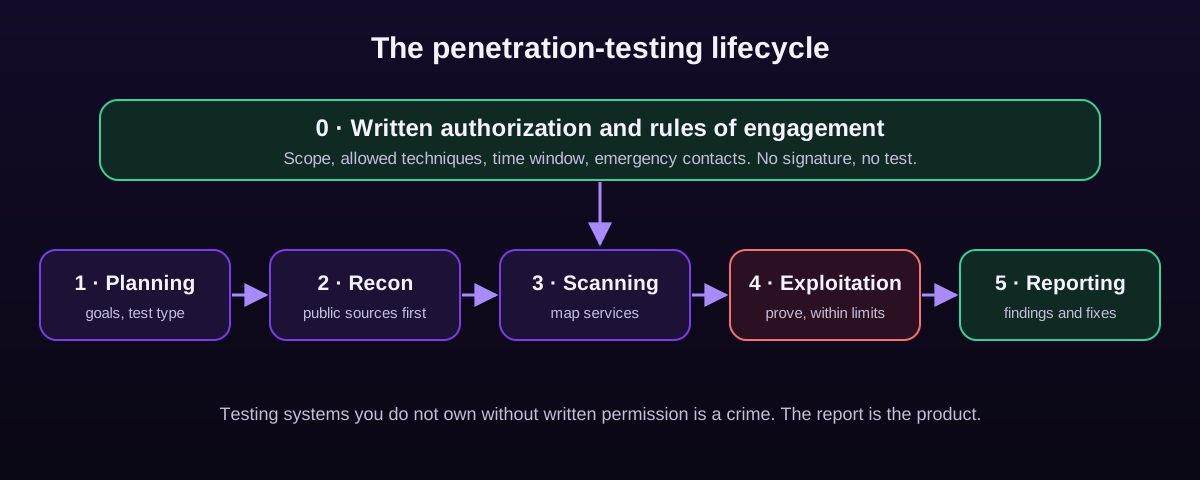
Phase 0: authorization and rules of engagement
Before any technical work, the tester and the client agree in writing on the scope (which systems, addresses and applications are in, which are out), the time window, the techniques allowed (is phishing staff allowed? physical entry?), who to call if something breaks, and how sensitive data found during the test will be handled. This document is what makes the test legal and what protects both sides. NIST’s technical guide to security testing (SP 800-115) treats planning and rules of engagement as a formal phase, not a formality.
Phase 1: planning
The team decides what the test is trying to answer. “Can an outsider reach customer data?” leads to a different test from “What can a malicious employee do?” The type of test matters too: black-box (the tester starts with no inside knowledge, like an outside attacker), white-box (full documentation and access, to find as much as possible) or grey-box, somewhere in between.
Phase 2: reconnaissance
Reconnaissance gathers information about the target, first passively (public sources, without touching the target’s systems) and then actively. MITRE ATT&CK lists reconnaissance as the first tactic in an attacker’s playbook, which is exactly why defenders care about it: what a tester can learn here, a criminal can learn too. The next lesson covers open-source intelligence in detail.
Phase 3: scanning and enumeration
The tester maps what is reachable: which hosts respond, which services and versions they run, and which of those have known vulnerabilities. Vulnerability databases and severity scores such as CVSS help decide what is worth attention. Scanning is noisy by nature, which is why a good SOC should notice it; if the client’s monitoring does not see the test, that is itself a finding.
Phase 4: exploitation
Exploitation means actually using a weakness to gain access, within the agreed limits, to prove that the risk is real rather than theoretical. Professionals choose the least disruptive way to demonstrate impact, stop when they reach the agreed objective, and never keep data they do not need. Post-exploitation (what an attacker would do next, such as escalating privileges) is covered in the last lesson of this course.
Phase 5: reporting
The report is the real product. A useful one has two parts: an executive summary that explains business risk in plain language, and a technical section with each finding, its severity, evidence, and clear steps to fix it. The best reports also note what worked well and what the defenders detected, because a test that only lists failures misses half the lesson. A retest after fixes confirms the gaps are really closed.
Penetration test, red team, bug bounty
| Exercise | Goal | Defenders know? |
|---|---|---|
| Vulnerability scan | Find known weaknesses automatically, broadly | Yes |
| Penetration test | Find and prove as many weaknesses as possible in a scope | Usually yes |
| Red team exercise | Test detection and response against a realistic, goal-driven adversary | Often only a few people know |
| Bug bounty | Let independent researchers report flaws under published rules, for rewards | Yes, rules are public |
All four are legitimate only inside a clear agreement. That shared foundation, permission first, is what the security profession is built on.
Главное
- A penetration test is a permitted, scoped simulation of an attack; without written authorization it is a crime.
- Rules of engagement define scope, allowed techniques, timing and emergency contacts.
- Phases: planning, reconnaissance, scanning, exploitation, reporting.
- The report, with clear fixes and a retest, is what makes the test valuable.
Проверьте себя
1. What makes a penetration test legal?
- Using only well-known tools
- Written authorization and agreed rules of engagement from someone entitled to give them — Верно.
- Not changing any data
- Testing only at night
Without explicit, written permission and scope, the same activity is unauthorised access.
2. In a black-box test, what does the tester start with?
- Full source code and credentials
- No inside knowledge, like an outside attacker — Верно.
- Physical keys to the building
- The company’s SIEM access
Black-box tests simulate an external attacker with no prior information.
3. Which is the real deliverable of a penetration test?
- The list of tools used
- A report with findings, evidence, severity and clear remediation steps — Верно.
- A screenshot of access
- The tester’s invoice
The report turns the test into fixes; a retest confirms them.
Примените на практике в FireAI
Примените этот урок на своём Mac.
- Правила: приложение, сайт, домен, IP или диапазон, навсегда или до перезагрузки — Напишите правило, точное как один адрес, или широкое как целый домен.
- Карта мира — Видьте, куда на самом деле уходят ваши данные, а не просто имя хоста, которое пришлось бы искать самостоятельно.
- Находите приложения с известными уязвимостями — Закройте известные бреши прежде, чем ими воспользуются: обновите то единственное приложение, которому это нужно.
- Режимы безопасности: Дом, Кофейня, Параноидальный, Под атакой — Подстройте строгость FireAI под реальное местоположение вашего Mac одним касанием.
- Исследовать подключение — Принимайте решение, опираясь на факты перед глазами, а не на смутное предупреждение.
Источники
- NIST SP 800-115: Technical Guide to Information Security Testing and Assessment
- NIST CSRC Glossary: penetration testing
- MITRE ATT&CK: Reconnaissance (TA0043)
- FIRST: Common Vulnerability Scoring System (CVSS)
- UK Computer Misuse Act 1990
- U.S. Department of Justice: policy for charging cases under the Computer Fraud and Abuse Act
Примените это на своём Mac
Все функции бесплатно на 17 дней, без банковской карты.