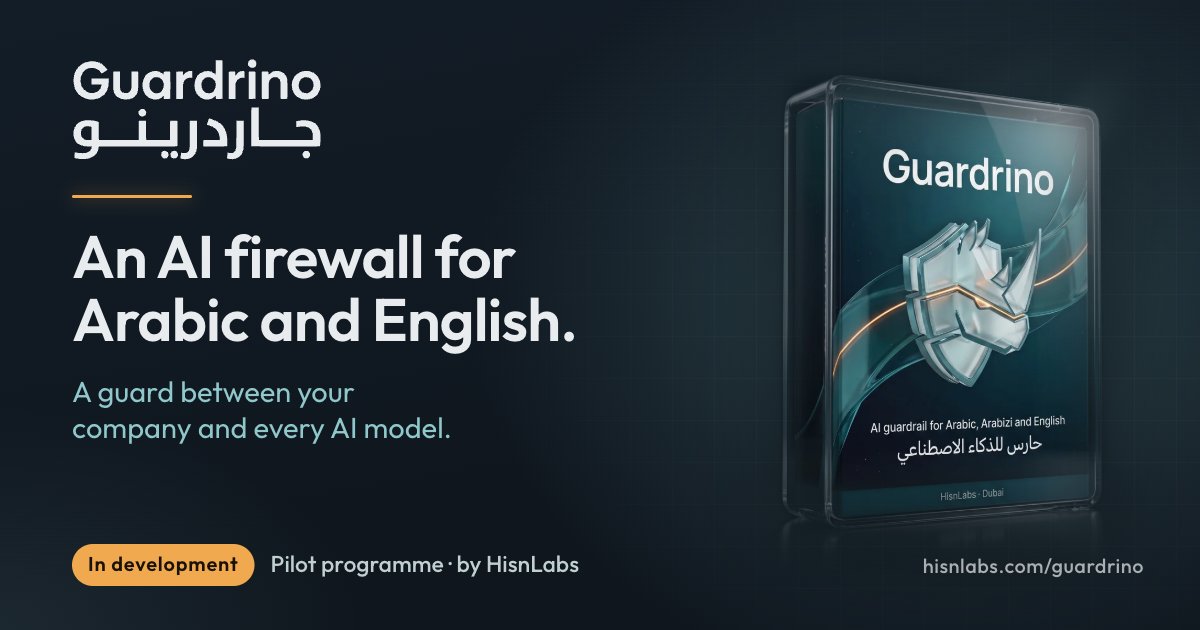
HisnLabs, the company that makes FireAI, is building Guardrino, a guardrails gateway for businesses in the Middle East that use large language models in Arabic and English. Guardrino is meant to sit between a company's staff, its AI agents and the models they call, and to check each message in both directions [1]. It is in development: there is no public version, no price and no release date, and HisnLabs is looking for a small number of pilot organisations. The statements below come from the Guardrino product page and describe a planned design, not tested results.
Background
A company that connects an assistant, a chatbot or an agent to a language model opens a new path for data in both directions: text typed by staff, documents an agent reads and the answers streamed back all pass through the model. The OWASP GenAI Security Project lists prompt injection as the first risk for LLM applications. It defines it as a vulnerability that occurs when prompts alter a model's behaviour or output in unintended ways, and states that, given the stochastic nature of the models, it is unclear whether fool-proof methods of prevention exist [2]. HisnLabs argues that many guardrail filters learn mostly from English, so that Gulf and Egyptian dialects, mixed Arabic and English, look-alike letters and Arabizi (Arabic written in Latin letters) either slip past them or cause ordinary Arabic messages to be blocked by mistake [1].
What HisnLabs describes
According to the product page, Guardrino is designed as layered checks. A first step undoes the tricks that hide text from filters, such as invisible characters, look-alike letters, hidden encodings, stretched letters and Arabizi. Fast checks then look for personal data common in the Gulf, such as Emirates IDs, Saudi IDs, IBANs and phone numbers, and for leaked keys and passwords. Language-aware checks look for prompt injection and data-theft attempts in English, Arabic and its dialects, and a deeper review runs only for the few messages that are still unclear [1].
Each message is to receive a risk score rather than a yes or no. A policy set by each company turns that score into one of five outcomes: allow, mask, warn, ask the user to rephrase, or block. Masking replaces personal data with a placeholder before the model sees it and puts the real value back in the answer, so the value itself is not sent to the model provider. HisnLabs also describes checks on answers while they stream, on the documents and web pages that agents read and on the tool calls they make, and lists voice and images as later items on its roadmap [1].
Two ways of running it are planned: a managed gateway hosted in the UAE, and an offline install on a company's own servers with no outside connection, for banks, government bodies and other organisations that cannot send data out. The pilot programme consists of a short call about the organisation's AI apps, languages and rules, a watch-only trial on its own traffic, and a report of what Guardrino would have masked, warned about or blocked [1].
Implications for organisations
The announcement concerns organisations in the UAE and the wider Gulf that run, or plan to run, AI apps or agents for Arabic-speaking staff and customers, such as banks, insurers, telecoms operators, healthcare providers and public bodies. Guardrino cannot be deployed today. An organisation that needs guardrails now has to rely on other tools and on its own controls, and can treat the pilot as a way to see how a guardrail behaves on its own Arabic and English traffic before any decision is made [1].
Recommendations
- List the AI apps and agents your organisation runs or plans, the languages and dialects your users write in, and the personal data that could reach a model.
- Test any guardrail on your own everyday Arabic and English messages, including Arabizi and mixed-language text, and count the ordinary messages it blocks as carefully as the attacks it stops.
- Prefer masking to blocking where the request is legitimate, so that users still get an answer.
- If you want to take part in the Guardrino pilot, request early access on the product page.
Relevance to FireAI
Guardrino and FireAI address different layers. FireAI is a network firewall for one Mac: it recognises AI agents such as Claude Code, Cursor and OpenClaw, learns where each normally connects and flags a first-ever destination or an upload spike for the user's review, without reading the content of the traffic [3]. It does not read prompts or answers, detect prompt injection in text or mask personal data. Guardrino is planned to work on the content of the messages exchanged with a model, for a whole organisation.
Limitations
Every capability described here is planned and comes from the vendor's own page; none has been released or independently tested, and HisnLabs states no customers and no measured results. The product page gives a design target for ordinary messages blocked by mistake and says that the pilot is where it will be measured [1]. The design may change during the pilot, and features listed for the roadmap may arrive later or not at all.
Companies interested in the pilot can request early access to Guardrino, by HisnLabs. Mac users can try FireAI, by HisnLabs free for 17 days.