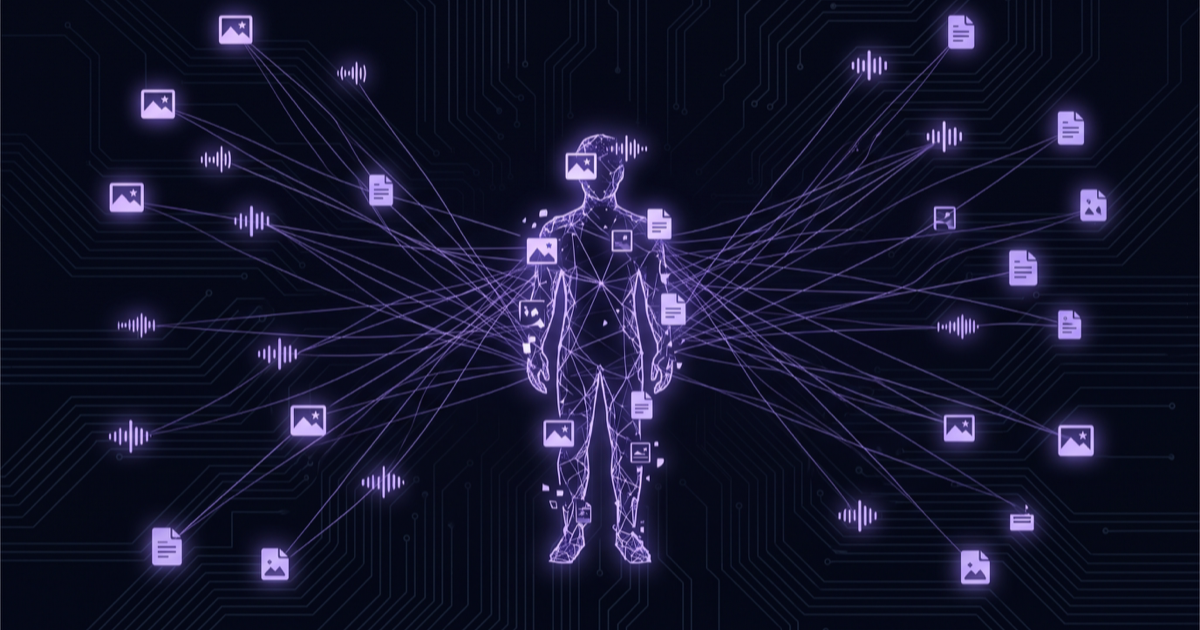
A "breach" used to mean one dramatic event: a company’s database, stolen in one night. That is still real, but it is no longer the main way an AI system builds a picture of you. The more common path is quieter: hundreds of small, individually unremarkable fragments — a geotagged photo, a voice memo, a LinkedIn job change, a leaked password from an unrelated service — that mean very little on their own.
Why fragments are now enough
Large models are good at exactly the task of finding patterns across scattered, messy data and filling in the gaps. Give a capable model enough public photos and it can infer a home neighborhood from backgrounds; enough short audio clips and it can approximate a voice well enough to fool a worried relative on the phone — which is precisely the scam the FTC warned about in March 2023, where criminals cloned a family member’s voice from audio the victim never knew was circulating.
The account that has never been "hacked"
This is what makes the threat hard to see: no single app on your Mac has to be malicious, and no single login has to be stolen, for a detailed profile to exist somewhere. Each app only ever sees the one fragment it collected — a location, a filename, a contact list sync — and has no idea it is contributing to something larger. The aggregation happens after the data leaves your device, on servers you never chose to trust.
What actually helps
- Strip location data (EXIF metadata) from photos before sharing them publicly — most photo apps have a one-tap option for this.
- Treat an unexpected, urgent voice call — even one that sounds exactly right — as a reason to hang up and call back on a known number, not a reason to act immediately.
- The fragments that matter most are the ones you never see leave: knowing which apps are quietly sending data, and to whom, is the only way to close that gap before it becomes a dossier.
How FireAI and HisnLabs fit in
None of this needs a single breach — it needs a hundred small ones, the kind that happen quietly every time an app phones home with a photo’s location, a login timestamp, or a device fingerprint.
FireAI is HisnLabs’ own product: an on-device AI firewall for Mac. It shows every connection your apps make, in plain language, and lets you decide what leaves your Mac — its AI runs locally, so your traffic is never sent to us or anyone else. HisnLabs’ security research team is the group that keeps that decision-making accurate: cataloguing which domains are ordinary telemetry versus a real product, tracking the country and network behind a connection, and training the on-device model (its Autopilot feature) on real traffic patterns, all without any of it leaving your Mac.
You can read the technical decisions behind it, or try FireAI for 17 days, at FireAI, by HisnLabs.